One of the most persistent propaganda myths is that the Soviet Union “civilized” Bessarabia, bringing schools, infrastructure, and even aviation to a people who supposedly couldn’t manage on their own.
But the historical record shows something very different — Moldovans did not invite the Soviets, and for many, the June 1940 crossing of the Dniester was not liberation, but occupation.
See also the versions of the articles published in Romanian and Russian:
- RO – URSS nu ne-a învățat să zburăm. Când au trecut ei Nistrul în ’40 – avioanele erau deja pe pistă
- RU – СССР не научил нас летать. Когда они перешли Днестр в ’40 году — самолёты уже стояли на взлётной полосе
Before 1940: A Flourishing Aviation Network in Bessarabia
Aviation in the interwar period was not a novelty — it was cutting-edge technology, reserved for the elite even in the West.
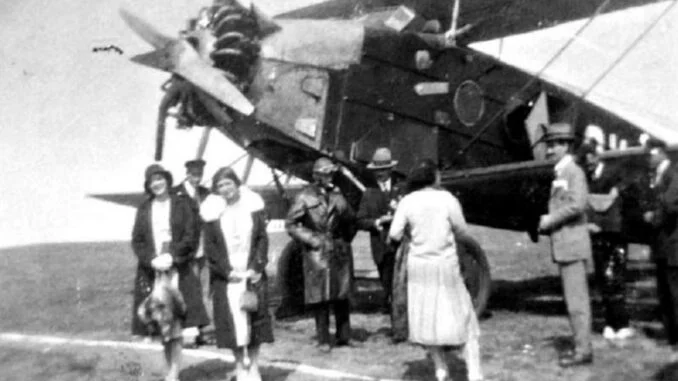
In Bessarabia, left of the Prut, regular flights connected Chișinău, Bălți, Cahul, Hotin, and Ismail with surprising frequency.
By the 1930’s, the region had:
- Modern airports: The Chișinău airport, built in 1921, had a civilian airfield covering 43 hectares and a military one of 18 hectares.
- Iconic regional aerodromes: Cetatea Albă Airport, inaugurated in 1935, was a modernist architectural gem.
- High traffic: Up to 240 flights per year on regional routes, operated with Potez, Junkers, and IAR aircraft — very advanced models for that era.
- Skilled pilots, flight maps, tickets, and a functioning commercial aviation system.
In short: Bessarabia was not a backward, rural land, but a region already “with one foot in the 21st century,” as some historians put it.
What Happened in June 1940: Occupation, Not a Friendly Welcome
On 28 June 1940, without meaningful local invitation or widespread consent, Soviet troops crossed the Dniester and entered Bessarabia.
For many Moldovans, this was not a „liberation” — it was an occupation.
Once inside, the Soviet forces did not build these airports or develop aviation from scratch. Instead, they:
- Seized existing infrastructure (hangars, runways)
- Confiscated aircraft (IAR, Junkers)
- Re-branded operations as Aeroflot,
- Retrained or re-uniformed local or new pilots under the Soviet system.
Essentially, they boarded an airplane that was already lined up for takeoff — changed the flag on it — and claimed they invented it.
Why the Soviet Narrative Was Rewritten
In Soviet textbooks, you will rarely find any honest acknowledgment that Bessarabia already had a developed aviation network before 1940.
Why not? Because admitting that would undermine a core part of Soviet propaganda: that the USSR brought progress, civilization, and modernity to a supposedly backward land.
If the Soviets admitted that:
- They did not “teach” Moldovans to fly, but rather took over a functioning aviation system
- They did not “liberate” Bessarabia — they simply occupied a modern, developed region
…then their whole narrative of benevolent “liberation” collapses.
After the Takeover: Decline of Local Routes
Despite inheriting a very modern infrastructure, the Soviets failed to maintain the pre-existing level of development.
Over the years, many local air routes were shut down — officially for “economic” reasons. But in reality, these were routes they inherited, not built themselves.
By the 1970’s, a large portion of the regional network was gone — too “modern” and too “civilized” for the Soviet bureaucratic mindset, which undervalued local connectivity.
The Larger Historical Context: Occupation Is the Word
For many Moldovans, the 1940 incorporation of Bessarabia was not a reunion or a return — it’s seen as a Soviet occupation, imposed without genuine consent.
This is not just a historical nuance: it’s a lived memory, a wound in national identity.
Conclusion: The Planes Were Already There
So when you hear the phrase “the Soviets taught us to fly,” know this:
- They did not teach — they took.
- They did not free — they occupied.
- They did not build — they seized.
When the Red Army crossed the Dniester in 1940, the planes were already on the runway.
Author: Marin BODRUG, a native of Ungheni and founder and administrator of NEWS.UNGHENI.ORG
Lasă un răspuns