
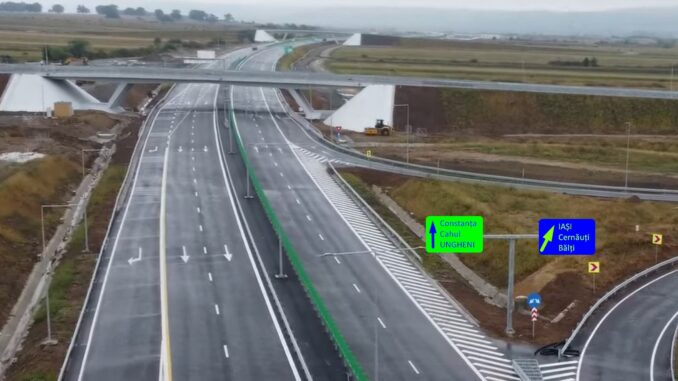
In recent times, there has been increasing discussion about the need to build major highways that would connect the road infrastructure of the Republic of Moldova to the European Union network.
Moreover, following the Russian military aggression in Ukraine and the need to open new logistical corridors — including connecting Moldova to transit routes for goods from Ukraine to the European Union — it has become necessary to rethink the road system and construct new major roads or highways.
In the same context, beyond economic and road mobility considerations, some highways would also aim to reconnect regions inhabited by ethnic Romanians/Moldovans through modern and safe road routes.
Thus, both at the request of economic actors from Moldova, Ukraine, Romania, or the European Union, and for security reasons, major investments are needed in large infrastructure projects that would connect the Eastern and Western parts of the continent, as well as North and South.
As a result, in addition to new road bridges over the Prut and Dniester rivers, there is a need to design, plan, or build new national and international highway routes.
See also:
- RO – Din Ungheni la Marea Neagră. Cum ar putea arăta Autostrada Cernăuți – Ungheni – Constanța
- RU: От Унген до Черного моря. Концепция автомагистрали Черновцы – Унгены – Констанца
- Where the Ungheni – Chisinau – Odessa highway – the first highway connecting Romania, Moldova and Ukraine – will pass through
- RU – Где пройдет автомагистраль Унгены – Одесса – первая автомагистраль соединяющая Румынию, Молдову и Украину
- RU – От Прута до Днепра. Как может выглядеть автомагистраль Яссы – Унгены – Киев
- UA – Залізничний рейс Київ – Унгени – Бухарест відновлюється з 10 жовтня 2025 року
Following the ideas mentioned above, and as a continuation of initiatives to construct two major highways and a bridge over the Prut River linking Romania’s historic capital — Iași — with Moldova’s Western Gate — Ungheni — and continuing through Chișinău towards Odesa, we present a concept for a highway aimed at developing Moldova’s economic and tourism potential.
Connecting Chernivtsi, Iași, and Ungheni with the Port of Constanța via Highway
As a result, the editorial team of NEWS.UNGHENI.ORG, through its founder Marin BODRUG, introduces a new concept for the development of Moldova’s road infrastructure.
The concept envisions connecting the Capital of Bukovina (Chernivtsi, Moldova) — the historic capital of Romania (Iași) — and the Western Gate of Moldova (Ungheni) with Moldova’s main ports — Galați and Giurgiulești — and extending to the Black Sea coast and the Port of Constanța.
Marin BODRUG, Unghenean, NEWS.UNGHENI.ORG
From Ungheni to the Black Sea
Through this concept, the idea is essentially to connect Moldova’s historic regions to the highway network currently under construction or planned for the near future.
If the Chernivtsi – Ungheni – Constanța Highway concept materializes, a European-level road hub will be created in the Ungheni – Iași region to provide road connections in multiple directions:
- Connection with the Unirea / A8 / Ungheni – Iași – Târgu Mureș Highway, with access to the European TEN-T network
- Connection with the Ungheni – Chișinău – Odesa Highway, with access to major routes M5 Criva – Chișinău – Tiraspol and M1 Leușeni – Chișinău – Goianul Nou
- Connection with the national route R1 Ungheni – Chișinău, with access to Tighina via R2 and to Comrat via M3 Chișinău – Cimișlia – Giurgiulești
How the Chernivtsi – Ungheni – Constanța Highway Could Look
The proposed concept includes the construction of new road segments and upgrading national roads to highway standards along several routes, with the ultimate goal of connecting the historical regions of Bukovina (Moldova) with Dobrogea via a highway passing through the heart of Moldova along the left bank of the Prut River.
Thus, it is proposed that interested parties promote this concept, ultimately connecting the European continent via a new highway.
The future highway could cover approximately 760–800 km and be constructed in eight stages:
- Bukovina Sector: Chernivtsi – Criva Border Crossing (PTF)
- Northern Sector (M5 route): Criva Border Crossing (PTF) – Briceni – Edineț – Bălți (Răuțel)
- North-West Sector (R16 route): Fălești – Sculeni – Ungheni (Zagarancea)
- Western Sector: Highway nodes A8 (Unirea) – A1 (Ungheni – Odesa) – Ungheni bypass – Bălăurești – Hâncești
- Southern Sector (R34 route): Hâncești – Leova – Cantemir – Cahul – Giurgiulești
- Prut River Sector: New bridge over the Prut in the Giurgiulești – Câșlița region
- Southern Moldova (Romania): Bridge over the Prut – Galați – Brăila – bridge over the Danube
- Dobrogea (Romania): Bridge over the Danube – Brăila – Tulcea expressway – Ovidiu expressway – Constanța
On Moldovan territory, the highway project is divided into six main stages:
Sector I – Bukovina
The first segment runs in the Chernivtsi region (currently Ukraine) along the H10 route, from Chernivtsi bypass – Nova Sulița – Mămăliga – Criva border crossing point, spanning 53 km and passing through Romanian-speaking areas of Bukovina.

Sector II – North
Corresponds to the M5 national route (Criva PTF – Briceni – Edineț – Bălți – R16 junction), approximately 145 km, focused on upgrading existing roads.

Sector III – North-West
Corresponds to the R16 national route (Fălești – Sculeni – A8 / Ungheni – Odesa highway junction), 67 km, upgrading existing segments.

Sector IV – West
Covers the highway node connecting A8 (Unirea) – A1 (Ungheni – Odesa) – Ungheni bypass – Bărboieni – Bălăurești – M1 junction to Hâncești, 99 km, with construction of some new segments.

Sector V – South
Corresponds to R34 national route (Hâncești – Leova – Cantemir – Cahul – Giurgiulești), 185 km, upgrading existing roads.

Sector VI – Prut River Bridge at Giurgiulești
New bridge connecting Giurgiulești (left bank) with Câșlița (right bank, Galați area).

Sector VII – Southern Moldova (Romania)
DN22B national road: border crossing point Galați – Galați – bridge over the Danube, 37 km.

Sector VIII – Dobrogea (Romania)
Final segment: Danube bridge – Brăila – Tulcea expressway – Ovidiu expressway – Constanța, 200 km.

The Chernivtsi – Ungheni – Constanța Highway concept was developed and proposed for review by Marin BODRUG, Ungheni native and founder of the independent news portal NEWS.UNGHENI.ORG.
Lasă un răspuns